Choosing the correct Ups Battery Voltage is a practical decision, not a label-matching exercise. It affects runtime, charging behavior, safety, efficiency, and replacement cost. A small office UPS may use a 12V battery module, while a larger system can require multiple 12V units connected in series. The numbers look simple. The consequences are not.
Uptime Institute’s Annual Outage Analysis 2024 identifies power-related problems as the leading cause of significant data-center outages. That finding makes battery selection more than a purchasing detail. An incorrect voltage can prevent a UPS from starting, damage charging circuits, or produce disappointing runtime. Eaton and Schneider Electric technical guidance also emphasizes matching battery strings with the UPS DC bus, load demand, and required autonomy. In practice, technicians should verify the UPS model, battery quantity, nominal voltage, float voltage, and connector layout before ordering anything.
Do not trust voltage alone.
A 48V battery bank may consist of four 12V batteries, but its usable energy depends on capacity, discharge rate, temperature, battery age, and power factor. The IEEE 1188 recommended practice highlights the importance of battery maintenance, testing, and service conditions for stationary applications. Field experience supports that warning: a battery cabinet can show normal voltage while delivering weak capacity under load. This guide explains how to calculate Ups Battery Voltage, compare series and parallel configurations, and avoid common sizing mistakes. Some simplified online formulas are useful, but they leave out heat, aging, and real operating conditions. That omission deserves careful reconsideration.
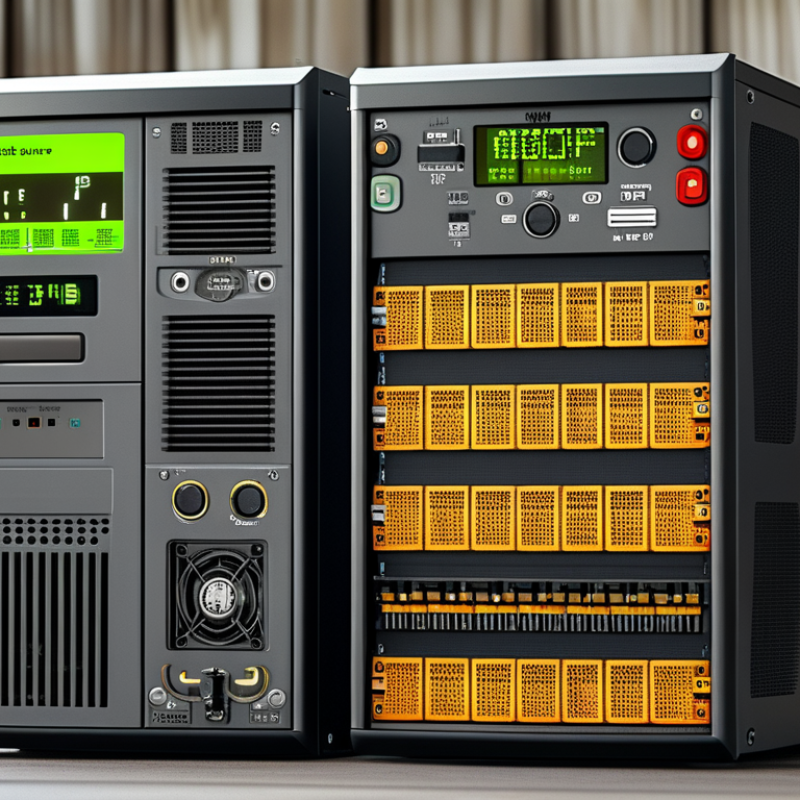
How to Choose the Right UPS Battery Voltage?
UPS Battery Voltage Basics and Its Role in Backup Power
UPS battery voltage is the direct-current voltage that feeds the inverter. The inverter then converts it into usable alternating current for connected equipment. A correct voltage keeps conversion efficient and reduces stress on internal components. An incorrect voltage may cause alarms, shutdowns, or permanent damage.
Most UPS systems use several batteries connected in series. For example, four 12-volt batteries create a 48-volt nominal battery bank. The actual charging voltage will be higher, so nominal voltage is not the whole story. Check the UPS specification label, service manual, and existing battery arrangement before replacing anything. Measure twice.
Voltage also affects current, heat, and cable losses. A higher-voltage battery bank usually carries less current for the same power demand. This can reduce heat in cables and improve efficiency. However, battery capacity is measured in ampere-hours, not voltage alone. A 48-volt pack may still provide limited runtime if its capacity is too small.
In field maintenance, a common mistake is matching physical size while ignoring electrical requirements. Do not mix batteries with different ages, capacities, or chemistries. Charging settings must match the battery type. Lead-acid and lithium-based systems require different control methods. I have seen runtime estimates fail because technicians trusted label voltage without testing battery condition. That detail matters. Room temperature, load changes, and aging can alter real backup time considerably.
| Nominal DC Battery Bus | Typical 12 V Battery Blocks in Series | Approximate Float-Charge Voltage* | Common UPS Capacity Range | Typical Applications | Primary Selection Considerations |
|---|---|---|---|---|---|
| 12 V DC | 1 block | Approximately 13.5–13.8 V | Up to about 1 kVA | Small office equipment, network devices, point-of-sale systems, and home workstations | Simple configuration, but higher current is required at the same power level than with a higher-voltage battery bus. |
| 24 V DC | 2 blocks | Approximately 27.0–27.6 V | About 0.6–2 kVA | Small servers, communications equipment, and compact office UPS systems | Offers lower battery current than a 12 V system while remaining relatively easy to service. |
| 36 V DC | 3 blocks | Approximately 40.5–41.4 V | About 1–3 kVA | Small server rooms, storage equipment, and extended-runtime installations | All series-connected blocks should have the same type, age, capacity, and state of charge. |
| 48 V DC | 4 blocks | Approximately 54.0–55.2 V | About 2–5 kVA | Network closets, small data rooms, security systems, and telecommunications equipment | A common balance between manageable service requirements and reduced DC current. |
| 72 V DC | 6 blocks | Approximately 81.0–82.8 V | About 3–6 kVA | Medium-sized IT loads and longer-runtime UPS installations | Requires careful series-string inspection because one weak block can reduce the performance of the entire string. |
| 96 V DC | 8 blocks | Approximately 108.0–110.4 V | About 5–10 kVA | Medium data rooms, industrial control systems, and critical communications loads | Reduces current and cable size compared with lower-voltage systems, but requires appropriate electrical protection. |
| 120 V DC | 10 blocks | Approximately 135.0–138.0 V | About 6–15 kVA | Commercial infrastructure, control systems, and larger server-room loads | Verify the UPS charging voltage, battery breaker rating, cable insulation, and service clearances. |
| 192 V DC | 16 blocks | Approximately 216.0–220.8 V | About 10–30 kVA | Medium-to-large data centers, industrial facilities, and centralized backup systems | Higher voltage improves power-transfer efficiency, but installation and maintenance require qualified personnel. |
| 240 V DC | 20 blocks | Approximately 270.0–276.0 V | About 20–40 kVA and above | Large critical-power systems, industrial loads, and centralized UPS installations | Use only when the UPS is designed for this battery bus; arc-flash and shock hazards increase with system voltage. |
Match the battery voltage to the inverter’s DC bus and charger range. Check the equipment specification sheet carefully. More voltage is not always better.
Higher voltage reduces current for the same power demand. A 10 kW load may draw about 93 amperes at 120 volts. At 240 volts, it may draw roughly 46 amperes.
Usually, lower current reduces cable heating, voltage drop, and copper requirements. However, higher voltage needs stronger insulation and better safety controls. The trade-off matters.
Longer backup time requires greater battery capacity. Confirm the inverter’s minimum and maximum voltage ranges. Also check battery quantity, cabinet space, and charger limits.
Cold conditions can reduce available capacity. Heat can accelerate battery aging. Keep the battery area cool, dry, clean, and properly ventilated.
No. A 48-volt system may require four 12-volt batteries in series. Confirm voltage, polarity, capacity, and battery condition before connection.
Shut down the system according to its instructions and isolate incoming power. Prevent accidental restart. Use insulated tools, eye protection, gloves, and suitable protective clothing.
Stop the installation and investigate. Measure each battery with a properly rated multimeter. Check polarity, cables, connectors, fuses, and terminal tightness.
Yes. Age, temperature, and storage history affect measured voltage and capacity. Do not rely on memory. Record battery order, readings, and connection layout.
Ask for a review when the system is large, unfamiliar, or difficult to verify. A loose connection can create heat. Overtightening may damage terminals. Mistakes happen.
Choosing the correct Ups Battery Voltage is essential for ensuring reliable backup power, stable performance, and safe operation. This summary explains the fundamentals of battery voltage and how it affects a UPS system’s runtime, efficiency, and compatibility. It also outlines how to match the battery voltage with the UPS input requirements, battery configuration, and expected load. By reviewing the system’s specifications and calculating the required voltage and capacity, users can avoid performance problems caused by under-voltage, over-voltage, or insufficient energy storage.
The article also examines key selection factors, including load demand, backup duration, battery type, operating environment, charging limits, and future expansion needs. Before installation, users should verify polarity, wiring, connectors, insulation, ventilation, and protection devices, while following the equipment manufacturer’s instructions and applicable safety standards. A careful evaluation and final safety check can help create a dependable UPS battery system that delivers consistent backup power and supports long-term, efficient operation.

 Liao Battery